


Redacción Alabrent
As a result, converters face growing pressure to deliver decoration solutions that not only catch the eye but also align with these modern expectations, creating a balance between aesthetics and purpose. For rigid containers - especially in food and industrial applications - In-Mold Labelling (IML) is emerging as a powerful answer. By integrating decoration directly into the molding process, IML eliminates secondary labelling steps, streamlining production while delivering high-quality, durable results. But what is the secret to unlocking its full potential? The answer lies in the coating.That's where ACTEGA comes in. As a global leading manufacturer in print and packaging, ACTEGA empowers converters harness the full power of IML with a portfolio of specialized coatings designed to meet the technical, aesthetic, and regulatory demands of today’s market.
A Seamless Fusion of Production and Decoration
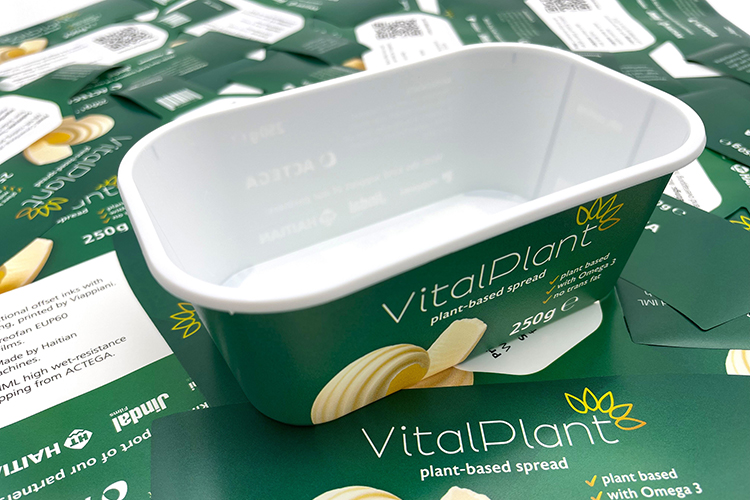
IML is a well-established method, particularly for injection-molded containers like yogurt cups, margarine tubs, and paint buckets. The process is elegantly simple: a pre-printed label is placed inside the mold - typically held in place by static electricity - before hot plastic is injected. As the plastic bonds with the label, decoration and container production are completed in a single, efficient step.
This integration delivers several advantages for converters. It removes an entire production stage, reduces handling, and supports scalability. It also enables the creation of mono-material packaging and can reduce plastic use, particularly in complex container shapes where other decoration methods struggle. “IML simplifies the process,” explains Andre Soterio, Global Manager IML at ACTEGA. “You’re decorating while producing the container - it’s fast, efficient, and delivers excellent print quality.”
The Unseen Advantage: The Critical Role of IML Coatings
While it may be a small part of the overall process, the coating’s impact is anything but minor. It is the key to ensuring everything runs smoothly, from printing the label to the final molding.
A high-performance IML coating is a multifunctional tool. Its primary function is to protect the printed image from abrasion, but its responsibilities extend far beyond that. It must provide vital heat and water resistance, ensuring durability during molding and end-use. It also delivers process stability during printing and die-cutting. Perhaps most importantly, the coating masterfully manages static electricity - it prevents unwanted static during printing but facilitates the precise static pinning required to hold the label perfectly in place inside the mold.
“The coating is like a piece of a puzzle,” the expert, Andre Soterio, continues. “It’s not just about protection; it's about enabling the entire process to work seamlessly. We look at the printing requirements, inks and films used, and desired effects to ensure the best possible result.”
A World of Finishes and Functions
"IML coatings open up a spectrum of creative and functional possibilities," Andre Soterio explains, "ACTEGA’s IML Coatings allow converters to achieve everything from subtle matte to striking high-gloss and textured finishes that heighten shelf appeal. Choosing the right coating technology depends heavily on regional printing capabilities, application requirements, and local regulations. The three main types - water-based, UV-curable, and solvent-based - each offer distinct advantages. Water-based coatings hold strong in Europe, recognized for their low migration risk, affordability, and compatibility with offset printing - making them especially suitable for food packaging. In contrast, UV-curable coatings, with their crisp clarity and gloss, are prevalent in Asian markets but are chosen more selectively for food applications due to migration and safety concerns."
With nearly all printing technologies - from digital and letterpress to flexo, gravure, and silkscreen - adaptable to IML, the coating must align not just with the decorative ambitions of the brand, but also the technical realities of the print and molding processes. Beyond chemistry, achieving optimal results hinges on technical precision. As Andre Soterio points out, this requires meticulous attention to the type of ink system, label design complexity, and the desired visual effect. Technically, this means ensuring uniform mixing of the coating for complete transfer of key additives. Furthermore, precise selection of anilox rollers and careful dryer calibration are essential for consistent application and performance. Ultimately, the right coating marries aesthetics with function, helping products stand out while supporting reliable manufacturing from start to finish. These technical details are where ACTEGA's expertise makes a significant difference, helping converters and printers avoid common pitfalls and enhance productivity. One of the key innovations is developing coatings that reduce build-up inside the mold, minimizing downtime for cleaning and keeping production lines running efficiently.
A Growing Market with Global Potential
Though a niche segment at just 2% of the global label market, IML’s growth is strong.
Europe leads the way, accounting for over 50% of the total market. However, other regions are rapidly closing the gap. North America, traditionally a blow-molding market, is seeing considerable growth in injection of IML - over 20% - as local production capabilities expand. Asia, particularly India, is experiencing a boom as new brands embrace IML. Furthermore, emerging markets in Africa and South America show immense potential. “As global brands expand into these regions, they are looking for consistent, high-quality packaging that IML solutions can deliver,” Andre Soterio comments. In Brazil, for instance, Rami is a great example of how ACTEGA’s solutions are helping businesses achieve their packaging goals. The company experienced rapid growth, investing heavily to start producing margarine tubs. It’s exciting to see how IML is transforming the market globally, and we’re proud to be a part of this journey,” Andre Soterio comments.
"We are a world market leader, supplying our coatings to over 50 countries. Our goal is to deliver products that perform reliably everywhere, from the cold climates of Scandinavia to the warm weather of the Middle East.”
Building a Bold Vision for Tomorrow
As sustainability continues to shape the packaging industry, IML presents a compelling environmental advantage. Because the label and container are made from the same material (polypropylene), the final package is a mono-material product, which is inherently more recyclable than multi-material alternatives.The industry is now pushing the boundaries of what is possible. The ultimate goal is to create a truly circular economy for IML packaging.
By focusing on the entire lifecycle - from production efficiency to end-of-life recycling - ACTEGA is not only solving today’s challenges but also building a more sustainable future for packaging. By perfecting the unseen element of the coating, ACTEGA empowers printers and brand owners to create packaging that performs, protects, and persuades in one seamless step.