


Redacción Alabrent
Higher Press Speeds Through Fast Foam Compression and RecoveryPress speed is bounded by the slowest element in the system. In flexographic printing, the foam carrier in a plate mounting tape is frequently that element — a foam that cannot compress and recover quickly enough at high speeds introduces print defects that force the operator to back down the press to a speed where quality is maintainable. The relationship between foam compression speed and maximum press output is direct and significant.
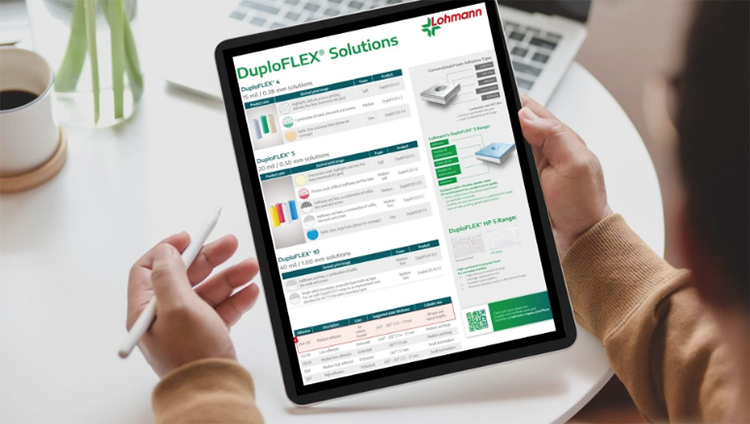
DuploFLEX foams are built with flexible polyethylene reinforcement on both sides of the foam core. This construction enables fast, accurate compression and recovery — the foam responds to the impression cycle quickly and returns to its original profile cleanly, ready for the next revolution. The result is a wider speed range over which consistent print quality can be maintained. For wide-web operations where press speed directly determines output volume, the ability to run faster without quality compromise is one of the more immediate efficiency gains available from a mounting tape selection.
Consistent Print Quality on Older Presses
New press infrastructure delivers controlled, stable mechanical conditions. Older presses do not — they introduce more variation in impression pressure, more susceptibility to vibration, and more sensitivity to speed changes. The conventional response is to compensate through press setup: slower speeds, more conservative impression settings, more frequent make-ready interventions. Each of these is an efficiency cost.
The DuploFLEX foam construction's vibration-damping characteristics and the OVX 201 adhesive's resistance to plate bounce reduce the sensitivity of the print process to exactly the kind of mechanical variation that older press infrastructure produces. The plate remains stable under conditions that would cause movement or bounce on a less capable mounting system, maintaining print quality at speeds and impression settings that would otherwise require compromise. For America's operations running a mixed fleet that includes older press models, this is a meaningful practical advantage — consistent quality output without the speed penalty that older equipment would typically impose.
Shorter Make-Ready Through Simplified Plate Mounting
Make-ready time is press time that generates no sellable output. Reducing it is among the highest-value efficiency improvements available in a high-throughput print environment, and the mounting tape is one of the variables that directly determines how long it takes.
The OVX 201 adhesive removes three steps from the standard plate mounting workflow. Primer application before mounting is eliminated — the plate-side adhesive holds edges securely without it. Supplementary edge-reinforcement tape is no longer needed for the same reason. And the air-channel structure on the adhesive surface allows air to evacuate during mounting rather than becoming trapped, removing the bubble-clearing step that can add several minutes to each plate change. The combined effect is a plate mounting cycle that is faster from start to first good impression. On a press running multiple plate changes per shift, the accumulated time saving across a week of production is substantial — and the cost reduction follows directly.
Conclusion
The efficiency gains delivered by DuploFLEX with the OVX 201 adhesive operate at three distinct points in the production cycle: faster press speeds through improved foam performance, more consistent quality under variable mechanical conditions, and shorter make-ready through a simplified mounting workflow. Each is a real cost reduction — in press time, in substrate, in labor — and the three compound across every shift the press runs.
For wide-web flexible packaging printers in the considering where mounting tape selection fits into their efficiency picture, the OVX 201 adhesive offers a concrete starting point. Find out more at lohmann-tapes.com/duploflex