


Redacción Alabrent
For converters running conventional offset alone, the honest answer is often no. Plate costs eat away at the margin on short runs, makeready time is fixed regardless of job length, and when four SKUs mean four separate setups, the economics collapse quickly. That gap is where digital production is winning work, and it’s a pattern that shows no sign of slowing.The productivity case for digital
At the moment, digital printing in folding carton is low penetration, but high value. While representing just 0.5% of folding carton print volume at the moment, analysts predict its growth to double by 2028.
More telling still is the addressable market. Around 20% of total folding carton volume is structurally suited to digital production right now, based on run length, turnaround requirements, and variant complexity. The gap between 0.5% penetration and 20% addressable volume is not a sign that digital is struggling to gain traction, but the size of the opportunity still to be captured.
Speed matters, but flexibility is what converters are actually paying for
Raw speed is not the primary reason converters invest in digital presses. The real value is what speed combined with flexibility makes possible.
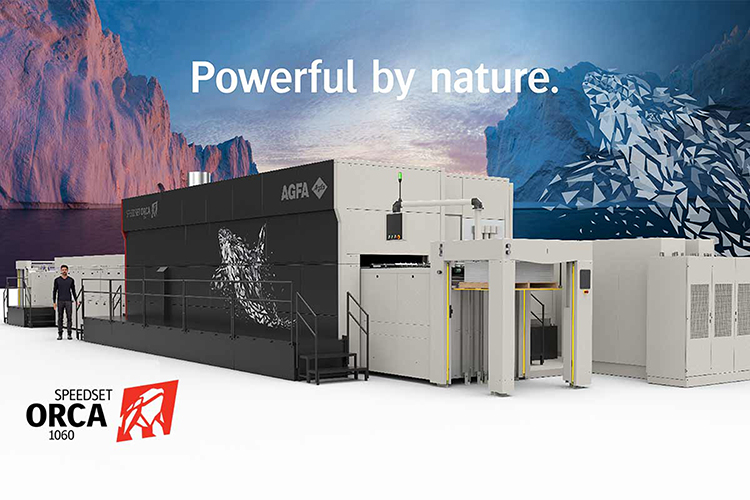
The SpeedSet Orca runs with no plates and no makeready waste, so a job changeover takes minutes. A converter can run a 500-unit test marketing job, switch immediately to a 2,000-unit seasonal launch, and follow that with a regulatory update reprint, all within a single shift and all at a cost per unit that makes each job commercially viable. Offset cannot do that, at least not profitably.
The substrate range reinforces this point. The SpeedSet Orca handles 0.2mm paper through to 2mm microflute, covering folding carton, shelf-ready packaging, and micro-corrugated within a single press. Converters running mixed work production do not need a specialist machine sitting idle between short-run jobs; they need powerhouse production equipment that earns its floor space every day.
Automation used intelligently
The global print industry is seeing well-documented challenges in its workforce pipeline. Skilled press operators are harder to find and more expensive to retain than they were five years ago, and offset presses require that expertise. Skills such as colour calibration, register, and makeready management are skills built over years, and the workforce that holds them is steadily ageing out.
The SpeedSet Orca integrates with Agfa’s Asanti workflow software, which automates job planning, colour management, and production scheduling. Consistency is built into the system, rather than reliant on individual operator knowledge. This means converters can keep operators focused on other high-value tasks, maintain output quality with leaner teams, and onboard new operators in weeks rather than years.
Asanti’s StackFlow capability goes further for converters managing multi-location retail fulfilment. Using pre-collated content lists based on order data, it directs the press to produce folding carton blanks in the exact sequence they need to be packed and shipped, removing manual sorting from the downstream process and cutting the margin for error at scale.
Where offset still wins
Ultra-long runs still favour offset economics, and if a converter’s work is dominated by million-unit runs of a single SKU with stable artwork, digital is not the answer. The SpeedSet Orca is not designed as a replacement for every press on every floor.
The converters investing in digital capacity are not abandoning offset; they are building hybrid operations where each technology handles the work it is best suited for. Offset takes the long runs, digital takes everything else, and the volume of everything else is growing year on year.
That shift in the balance of work is what makes the hybrid position commercially strong. Jobs that previously went elsewhere become viable, relationships with brand owners deepen, and revenue from work that was previously unquotable comes onto the books.
The power of moving first
This pattern has played out before, in commercial print and in labels. Digital goes from a small niche to a necessary capability, not because it replaces everything, but because it captures the fastest-growing segment of the work.
The converters who moved early in those segments did not do so because they predicted the future perfectly; they moved because the economics of the work they were being asked to quote were already pointing in one direction.
In folding carton, the apex predators are the converters who recognise that shift and act on it. The SpeedSet Orca is built for exactly that move.